Dubai has once again reinforced its long-term vision with the announcement of the Metro Gold Line — a landmark infrastructure project that is set to redefine mobility, connectivity, and real estate dynamics across the emirate.
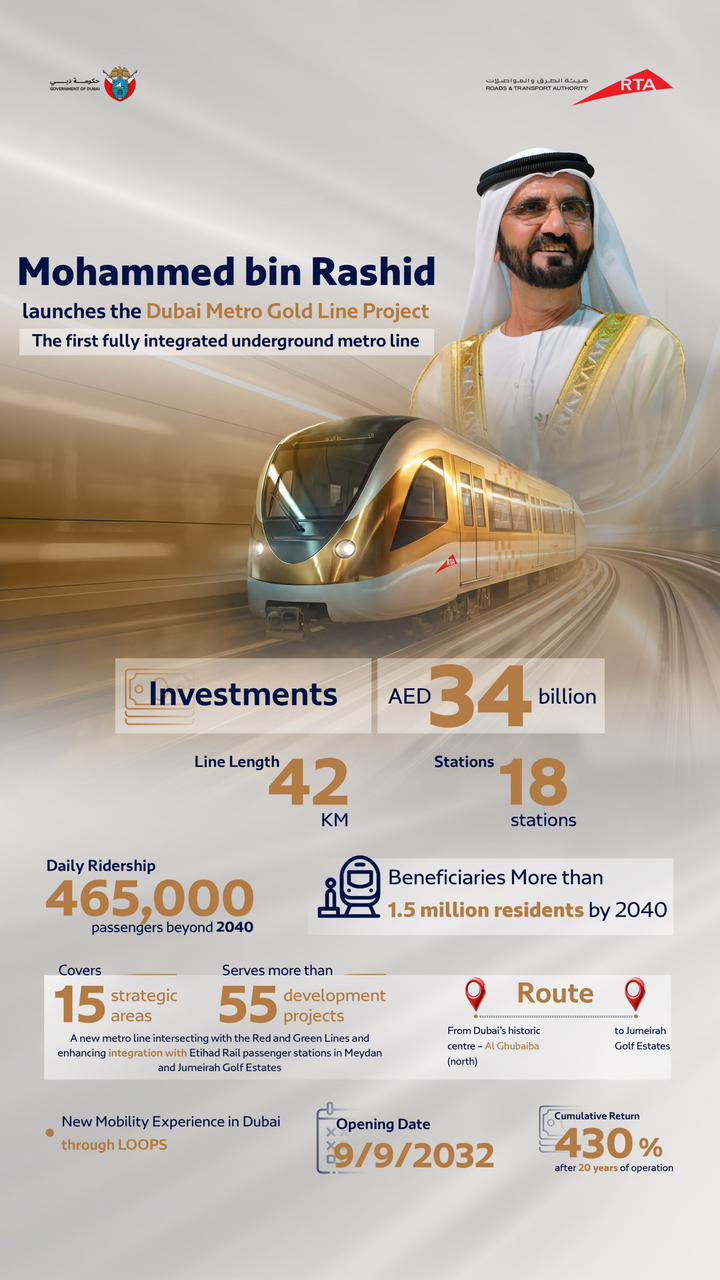
With a total investment of approximately AED 34 billion, the Gold Line is not just another transport expansion. It is a strategic move that signals where Dubai is heading next.
A New Artery Across Dubai
The Gold Line will span approximately 42 kilometres and feature 18 stations, making it one of the most significant additions to the Dubai Metro network to date.
The route will run from Al Ghubaiba, one of Dubai’s historic districts, through key urban corridors, ultimately connecting to Jumeirah Golf Estates.
In doing so, it will bridge the gap between Old Dubai and emerging residential and commercial zones, creating a seamless link between established and high-growth areas.
This is a clear indication of Dubai’s ongoing urban evolution — connecting heritage with future master-planned communities.
Integration with the Wider Transport Network
One of the defining features of the Gold Line is its integration into a broader, multi-layered transport ecosystem.
The line will connect with the existing Red and Green Metro lines, while also linking to the UAE’s national railway network, Etihad Rail, at key interchange points such as Meydan and Jumeirah Golf Estates.
This transforms the Gold Line from a city-level transport solution into a national mobility corridor, enabling seamless movement not just across Dubai, but between emirates.
As Etihad Rail prepares to connect major cities across the UAE, the Gold Line positions Dubai residents and investors at the centre of a fully integrated transport network.
Serving Growth Corridors and Strategic Locations
The route has been carefully designed to pass through 15 strategic areas, including Business Bay, Meydan, Al Barsha South, Jumeirah Village Circle, and Dubai’s expanding residential districts.
These are not random locations. They represent some of the most active development zones in Dubai today — areas where population growth, infrastructure, and real estate investment are already converging.
By linking over 55 major real estate developments, the Gold Line directly supports both current communities and future supply pipelines.
This level of alignment between infrastructure and real estate is a key reason why Dubai continues to outperform other global markets.
The First Fully Underground Metro Line
The Gold Line will also be Dubai’s first fully underground metro corridor, marking a major advancement in engineering and urban planning.
Beyond the technical achievement, this ensures minimal disruption at street level while maximising efficiency and speed across key districts.
It reflects Dubai’s continued focus on long-term, sustainable infrastructure development rather than short-term expansion.
The First Fully Underground Metro Line
Infrastructure has always been one of the strongest predictors of real estate performance in Dubai.
Historically, properties located near metro stations have seen higher rental demand, improved occupancy rates, and stronger capital appreciation. In many cases, values increase by 5% to 20% depending on proximity and quality of the development.
The Gold Line is expected to serve over 1.5 million residents and significantly reduce travel times across the city, further enhancing the attractiveness of connected communities.
For investors, the implications are clear.
Areas along the Gold Line corridor are likely to experience accelerated demand, increased liquidity, and long-term price growth as connectivity improves.
A Long-Term Vision Backed by Execution
Scheduled for completion in 2032, the Gold Line is not just about today’s market. It is about positioning Dubai for the next decade of growth.
The project is expected to expand the metro network significantly and reinforce Dubai’s position as one of the most connected cities globally.
More importantly, it demonstrates a consistent pattern: infrastructure investment precedes real estate growth.
Final Perspective
Dubai’s Metro Gold Line is more than a transport project. It is a strategic signal to investors.
It highlights where future demand will be concentrated, where connectivity will improve, and where long-term value will be created.
For those looking at Dubai real estate from an investment perspective, this is exactly the type of development that should not be overlooked.
Frequently Asked Questions
The Dubai Metro Gold Line is a newly announced metro expansion project designed to enhance connectivity across the city. It will span approximately 42 km and include 18 stations, linking key residential, commercial, and emerging districts across Dubai.
The Gold Line is expected to be completed by around 2032, forming part of Dubai’s long-term infrastructure and urban development strategy.
The route will connect major areas including Al Ghubaiba, Business Bay, Meydan, Al Barsha South, Jumeirah Village Circle, and Jumeirah Golf Estates, linking both established and high-growth communities.
Yes, the Gold Line will integrate with the existing Red and Green Metro lines, and is also expected to connect with Etihad Rail, creating a seamless national transport network across the UAE.
The Gold Line is planned to be Dubai’s first fully underground metro line, designed to improve efficiency while minimising disruption to existing infrastructure.
Infrastructure developments like metro expansions typically drive higher demand, improved rental yields, and long-term capital appreciation in nearby areas. Properties located close to metro stations tend to perform stronger due to increased accessibility.
Communities along the route, particularly emerging areas such as Meydan, JVC, and Al Barsha South, are expected to see increased investor interest due to improved connectivity and accessibility.
Early investment in areas benefiting from major infrastructure projects often provides the strongest upside potential, as property values tend to increase as construction progresses and completion approaches.
The Dubai Metro Gold Line will feature approximately 18 stations strategically located across key districts in the city.
Infrastructure is one of the main drivers of real estate growth in Dubai. Improved transport links increase accessibility, attract residents and businesses, and enhance overall demand, leading to stronger long-term returns.
Want to Invest Near the Dubai Metro Gold Line?
Discover high-potential communities, upcoming projects, and investment opportunities expected to benefit from Dubai’s new Gold Line expansion.
Speak with Hassi Properties for tailored advice, project options, and a personalised investment strategy.
Book Your Free Consultation
Fill in your details below and our team will get in touch with suitable opportunities.